

Pre-School Music Program
Pricing and Information

Current Junior Music Program is in session, register any time. It runs weekly.
NEW Junior Music Program staring February 2026. Read more about it below.
Age group: Preschoolers (parents may participate)
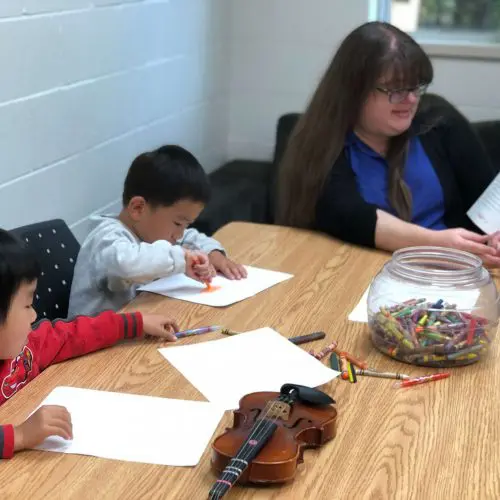
Duration: 45 minutes + 15 minutes of painting to music
Goal: To develop children’s sense of rhythm, pitch, coordination, attention, and imagination through musical and creative activities.
New musical pieces will be gradually introduced into the program to help children become familiar with the great masterpieces of world music.
We offer weekly Junior Program at our school. You may register your child.
Children need music. At Klaudia’s Music Studio, we believe that music is an essential element of every child’s education.
For young children from age 3.5 years old we offer the most amazing music program. It runs weekly on Saturday afternoons.
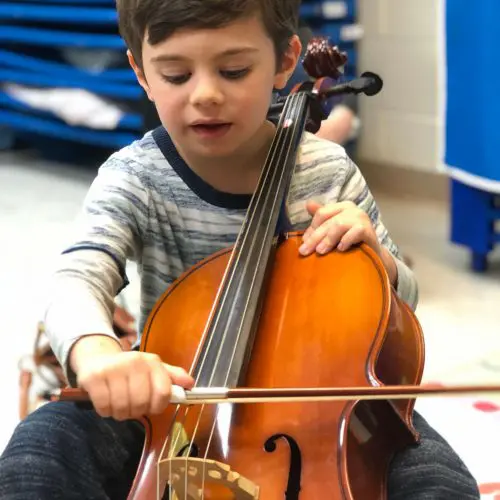
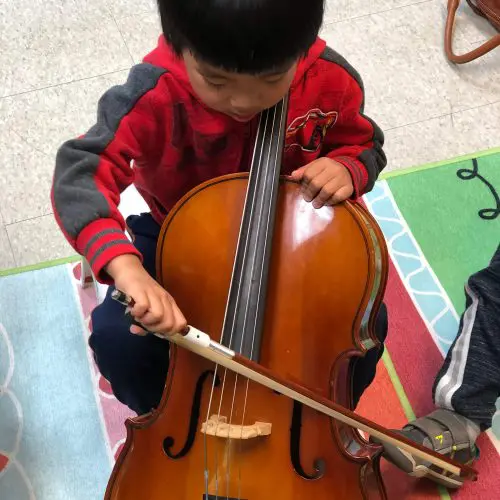
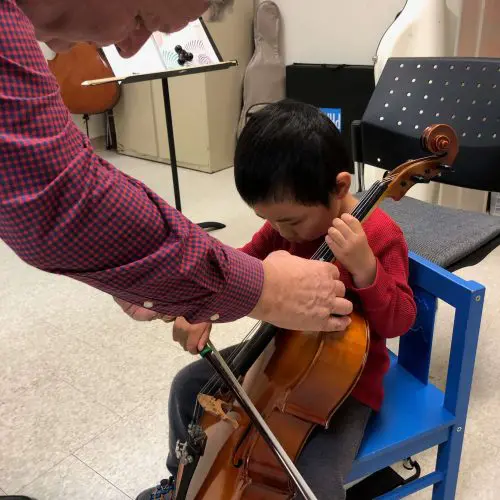
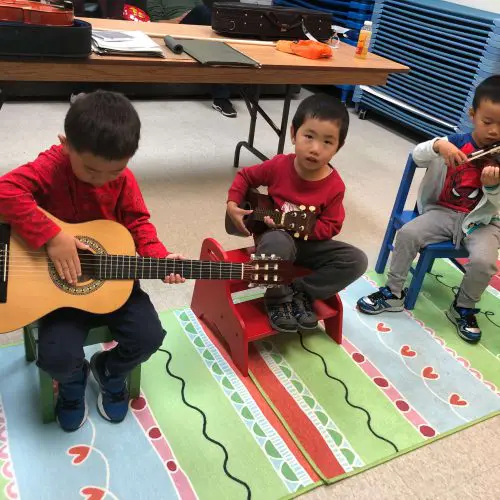
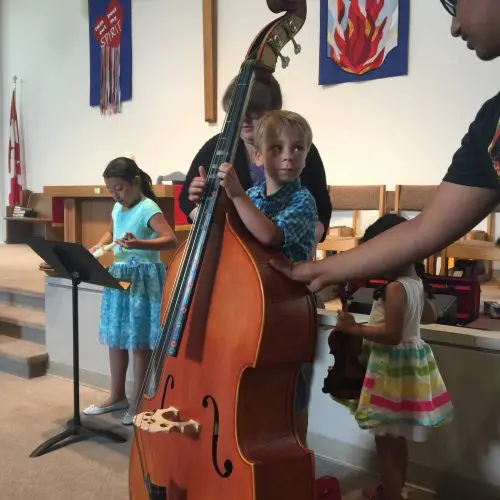
Designed for children 3.5-5.5 years old without or with previous musical experience, this class is geared toward trying different musical instrument and hands-on playing. Activities include, classical music, nursery rhymes, instruments trial, percussion to the beat, movement and play. It helps with the decision about what musical instrument is the closest to the heart of the child.
Having fun with music while learning is the key! No musical instruments needed, all is provided for you. These lessons are not parented, although parents are welcome to stay in the class, or observe from outside the classroom at any time. Classes are lead by a music teacher and dedicated volunteers.




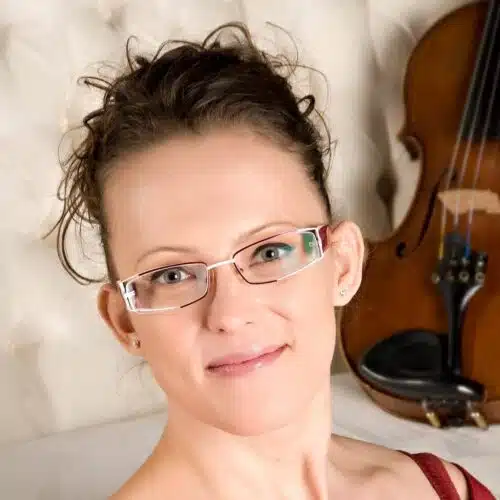

Klaudia Thibault is an experienced violin and viola teacher in Oakville. When you take lessons with her you can expect dedication, attention to details and consistency. All levels, all ages. Because she is also managing the entire music studio, you can expect a substitute teacher approximately once a month during her teaching year. Also, she is often called in to play with the local professional and community orchestras. Her lessons are engaging. She is using music backing tracks and modern technology aids, as well as musical games. Students play in group settings to gain important orchestral experience early on. Many of Klaudia’s past students became members of the Oakville Youth Symphony Orchestra which requires level 5 and up proficiency, and continued on their violin studies at university level. She has taught hundreds if not thousands of students over the years.
Klaudia regularly prepares students for the Royal Conservatory of Music (RCM) examinations, festivals and music competitions. She teaches all levels of RCM violin and viola, leads a unique summer violin summer camp and also conducts orchestra classes. Klaudia discovered over the years of playing and teaching how the posture affects the performance and abilities. Klaudia’s strong emphasis on correct posture and optimal set up makes her one of a kind, dedicated and determined teacher.
Klaudia Thibault, nee Mirossayova, studied in Slovakia with Rozalia Varcholova, Anita Mirossayova and in Canada with Amalia Canzoneri and Metro Kozak. Klaudia successfully completed 10 years of violin study in Slovakia (1984-1994: equivalent to Royal Conservatory ARCT) at the Jan Pöschl School of Music in Presov. Then, she graduated from the University of Prešov (Prešovska Univerzita), Slovakia, in 2001. She holds a Master’s Degree in Musical Education and Social Studies. In the latter part of 2001, Klaudia moved to Canada where she sought to become active and has since become established in the music community. She continues her education at strings workshops in USA and Canada regularly. Her strongest pursuit is perfecting student posture to achieve improved performance.
The daughter of a violin teacher Anita and an engineer Stanislav, Klaudia has been an enthusiastic violin player since five years of age, performing as a soloist and a youth classical music orchestra concertmaster since 1987. The youth orchestra “Orchester Jana Poschla in Presov” performed in Eastern and Western Europe, and obtained high marks at national Slovak competitions and international competitions each year. Most memorable was the competition in Neerpelt, Belgium where the orchestra received the golden medal. Klaudia’s mom Anita Mirossayova acted as a conductor of this highly successful student string orchestra.
In 1993, Klaudia joined the Slovak Folk Ensemble ”Sarisancek” and then “Šarišan”, a national music and dance group, traveling and performing on violin for the next six years in nine countries around the world: in Europe (France, Italy, Czech Republic, Ukraine), South America (Brazil) and North America (USA), Africa (Tunisia) and Asia (Malaysia, South Korea). Klaudia was a founder of music section of children folk group “Rozmarija” in Presov. She successfully lead the group of young musicians to become confident in their performance and traveled with them to Finland, Sweden and many other countries in Europe.
While studying at university, Klaudia won a university violin competition in her first year of study. After this, she was the concertmaster of the University Chamber Orchestra “Camerata Academica” for the next four years. In her graduation year 2001, Klaudia compiled and produced a one-hour orchestral educational program for children about the role of different musical instruments in orchestra; in addition to spoken word, she also conducted this 50-member youth university orchestra which performed her program at the Performing Arts Centre (PKO) in Presov, Slovakia to a 600-member audience. At that time, she also conducted a children’s string orchestra of classical music at the Jan Pöschl School of Music in Presov, Slovakia.
Between 2002 – 2013, Klaudia played with the Oakville Symphony Orchestra and it was the first year she was awarded the Oakville Symphony’s Young Artist Award thanks to Ian Morrison who suggested Klaudia take up this opportunity. Klaudia was given a $1500 scholarship for which she was eternally grateful. She met a lot of new friends and fellow musicians during her years with the Oakville Symphony. Klaudia has performed on violin with the Oakville Messiah Orchestra, Dundas Valley Orchestra, Oakville Chamber Orchestra, Masterworks Oakville, community orchestras and internal school orchestra at Klaudia’s Music Studio. In June 2005, she became a member of the String Quartet. She performs regularly at weddings and occasions throughout the year.
Klaudia was a member of the Oakville Symphony Orchestra’s Community Outreach Committee from 2005 – 2012. This committee introduced very successful series of mini-concerts and a full-orchestra concert for young people. Klaudia donated a quality student violin for seven consecutive years to the Poster Contest of the Oakville Symphony Orchestra as a main prize and the violin was presented to the winner at the full-orchestra concert each year. Each year, the Studio students perform at Retirement Home Residences in the community.
Klaudia’s most recent success with student is Level 10 Level violin exam achieving high mark of 81% in June 2023. Student is now in ARCT level and continues to study with Klaudia. In the past, successful exams marks were in high 80% to 90%. Klaudia teachers newly established group violin beginner classes since September 2023. One is for children, one is for adults. Advanced experienced students of studio are part of Orchestra Apollo 11 is the mixed levels mixed ages all-inclusive student orchestra established in April 2023, performing with great success.
Klaudia started to teach violin at the Jan Pöschl School of Music in Presov, Slovakia in 1997, and has been teaching continuously ever since. In 2002, she established Klaudia’s Music Studio in Oakville. Klaudia educates young students (3 years of age and up). She has been successful in preparing students of all ages and levels of experience for Royal Conservatory of Music exams, and Hamilton and Toronto music festivals.
Klaudia presents recitals bi-annually in winter and summer, giving parents the opportunity to enjoy their child’s musical progress and allowing students to perform in public thereby building stage-performance skills and confidence. She also organizes teachers concerts designed to inspire. She takes immense joy in all its achievements at concerts, competitions and festivals.
Heather is a Hamilton-born musician who recently returned to the area after studying at Wilfrid Laurier University in Waterloo and the University of Victoria, where she obtained master’s degrees in English and music composition, respectively. She has been playing piano for over twenty years – as the story goes, when she was six she started talking about taking piano lessons and, when her parents finally got tired of hearing about it, they gave in and signed her up at a music studio. Of course, she’s never looked back!
At UVic, Heather completed her master’s degree in music composition under the supervision of Christopher Butterfield and John Celona, and took every opportunity to take part in collaborative performances, including working extensively with two graduate-level vocal performance majors as an accompanist. During her undergrad at WLU, she studied composition with Dr. Peter Hatch and Linda Catlin Smith, studied piano with Leslie De’Ath, and took courses in piano pedagogy and vocal and instrumental accompanying. In fact, Heather has extensive experience as an accompanist, and while primarily a pianist, she also has experience performing on fortepiano, celeste, and organ.
Heather is currently the Director of Music at Carlisle United Church where she plans and leads choir rehearsals and provides music for Sunday and special services. She has previously taught piano in both studio and private settings, and has fulfilled the role of Teaching Assistant for university courses in musical skills, theory, and history as well as poetry in English. She also enjoys and has experience in working with children and youth, whether in a musical setting, in a community group, or in a local library as a literacy worker. Heather is happy to be able to share her passion for music and her love of teaching with students at Klaudia’s Music Studio, and she believes that making learning fun is a major part of what will foster a love of music in children, encourage the progression of their musical studies, and instil good learning habits that are transferrable into other areas of education.
WHERE:
DROP IN:
MEMBERSHIP:
HOLIDAY CLOSURES
Winter Break: Two full weeks closed
March Break: Lessons on the 1st weekend, off the second weekend
Read this article related to our program:
From the earliest age, children respond to music through movement and imitation, clapping their hands and babbling to their favorite music. When caregivers and teachers encourage and guide them, any child can develop basic musical competence, learning to sing in tune and march to a beat.
Why is this important? According to early childhood educators, music is a basic life skill, as important as speaking, reading or writing. Music fosters cooperation and listening, expression and creativity, forces that are invaluable in every aspect of our lives.
Many scientists, inspired by the work of Harvard psychologist Howard Gardner, have come to consider “musical intelligence” as just one of many forms of human intelligence. And music has been shown to benefit a child’s broader education. In famous studies from the 1990s, University of Wisconsin psychologist Frances H. Rauscher determined that listening to Mozart’s music could actually enhance spatial reasoning.
More recently, research has confirmed that music instruction increases a child’s ability to work and play cooperatively with classmates. A few years ago Oakland University child psychologist Andrew Gunsberg showed that children engaged in improvisational musical play were able to perform much better on later cognitive tasks requiring focused attention. And in research published in February of this year, a Northwestern University neuroscientist, Nina Kraus, discovered that musical training enhanced brain stem sensitivity to speech sounds.
It is never too early (or too late) to enrich your child’s education through music. Our early childhood music program is aimed at young children, under Klaudia’s direction. These young musicians will be given freedom of movement & expression to music, participation in sing-along nursery rhymes in circle time with the others and also doing their own music making. The children’s final presentation and show is a part of our semi-annual School Recitals each December and June. We’ll help your youngster become more musical, more creative — and maybe even more intelligent!
Music can easily become child's passion. Here is how it is done:
10. Playing a musical instruments is a safe, fun, and creative after-school activity.
9. We take it seriously. Classical music tutoring of Royal Conservatory of Music enriched with variety of non-classical popular repertoire.
8. Learning to read notes and other musical aspects is taught as an essential element from the beginning.
7. Fantastic results in quality of sound, pitch and musicality.
6. Benefit of improved learning skills, such as coordination, listening, attention span.
5. Flexibility. You get to pick a day/time for weekly lessons, as well as the teacher.
4. Convenience. Close to your neighborhood.
3. Certified, experienced, kind and attentive teachers.
2. One ½ price initial trial lesson; then risk-free 10-WEEKS trial period; no obligation to commit.
1. MUSIC EDUCATION FOR LIFE!
Here you will find the most recent information on programs and events organized by Klaudia’s Music Studio, Oakville’s Premier School of music.
Click on the button below.